
New Haven County Arrest Records and Court Charges
New Haven County arrest records may identify an arresting agency, the person arrested, arrest date, alleged offense, and booking or custody context when that information is public. Connecticut no longer has a New Haven County sheriff jail roster, and custody information is statewide through the Department of Correction. The court charge record begins when the prosecutor files or pursues formal charges in Superior Court, where the charges become part of the docket.
That split matters. The arrest or booking side can point to custody status, while the court charge side shows what was actually filed, amended, reduced, nolled, dismissed, or resolved by conviction. New Haven court charges after arrest are usually found through the criminal/motor vehicle lookup for the relevant Superior Court location. For the full case file and sentencing history, use the New Haven County criminal court records page rather than treating the charge list as the whole record.
The manifest source for the New Haven GA23 Public Defender office directions is relevant because GA23 is one of the local venues where lower-level criminal and motor vehicle charges are handled.
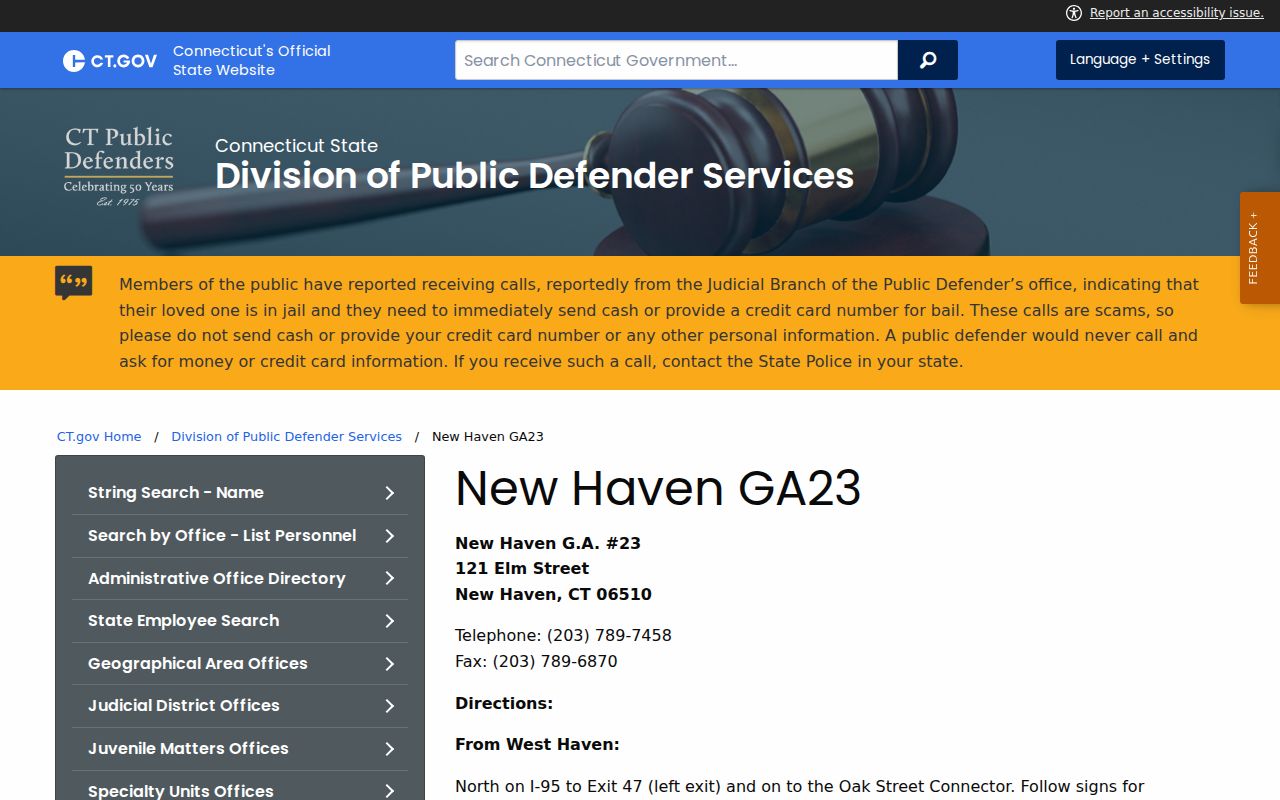
GA23 records are searched through court systems, while public defender contact is a separate legal-assistance channel for eligible defendants.
Find New Haven County Arrest Records and Charges
For filed charges, start with the Connecticut Judicial Branch Case Look-up hub and choose the criminal/motor vehicle path. The pending search by defendant accepts last-name prefix, first initial, birth year, court location, and case type. The pending search by docket number uses court code, case type, year, number, and suffix. Arrest or custody status is separate because Connecticut Department of Correction records are not county court charge records.
- Search the criminal/motor vehicle pending system by defendant name when no docket number is known.
- Narrow the search by New Haven GA23, Meriden GA7, New Haven Judicial District, or the known court code.
- Open the matching case and read the charge list, court location, events, and current disposition.
- Use docket-number search for exact follow-up once the court code, case type, year, number, and suffix are known.
- Contact the Chief Clerk, Bail Services, municipal police agency, or counsel when arrest, bond, or warrant status is not clear online.
For statewide criminal history, Connecticut law treats conviction and nonconviction information differently. Conviction information is public for any purpose under CGS 54-142k. Nonconviction information is generally more limited, and erased records are not released except as a statute allows. The public court lookup also omits youthful offender cases, juvenile cases, infractions, and violation convictions from the conviction display.
Charges After Arrest in New Haven
Connecticut uses State's Attorneys, not county district attorneys. The New Haven State's Attorney serves as chief law enforcement officer in the Judicial District of New Haven and supervises prosecution offices at the Part A Judicial Superior Court in New Haven, GA23, GA7, Juvenile Matters, and Housing Sessions. Geographical area offices in New Haven and Meriden primarily prosecute class C, D, and E felonies, misdemeanors, infractions, and motor vehicle offenses.
| Complaint | Information | Indictment | |
|---|---|---|---|
| Role | Initial written accusation or charging paper in a criminal matter. | Formal criminal charging document filed by the prosecutor. | Grand-jury charging document, less central to ordinary Connecticut state-court charge lookup. |
| Record effect | Can identify the alleged offense that starts court processing. | Defines the formal charge tracked through the docket. | Creates a formal charge in cases that use that process. |
| Where to confirm | Criminal/motor vehicle docket and clerk file. | Criminal/motor vehicle docket and clerk file. | Clerk file and case docket where public. |
The official Connecticut arrest-record statute is one source for public access to arrest information during a pending prosecution.
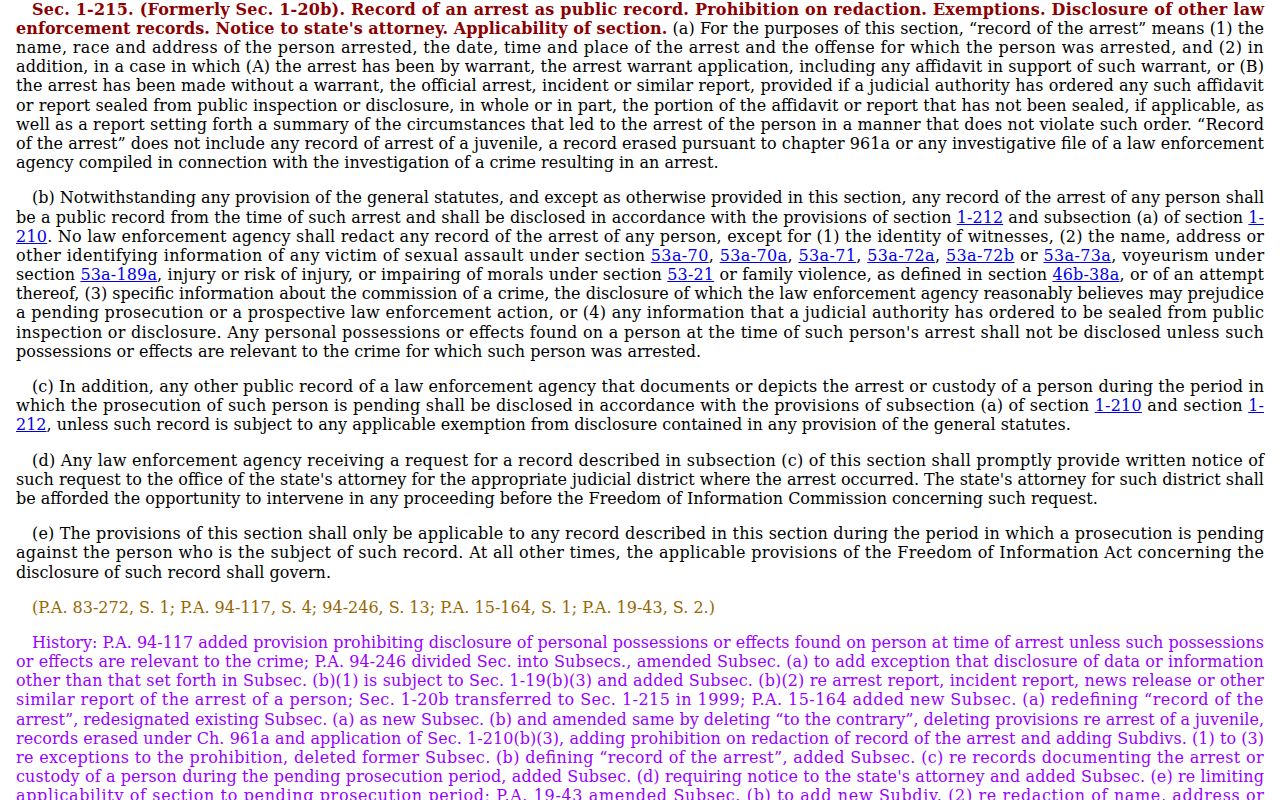
The statute supports access to arrest information, but the court docket is still needed to track what charges were filed and how they changed.
New Haven Charge Status Meanings
Charges after arrest can change many times before final disposition. A prosecutor may amend or reduce a charge, add a new count, enter a nolle, or proceed to plea or trial. The court may dismiss a charge or enter a judgment after a plea or verdict. One arrest can produce multiple charges, and each charge can have its own status, which is why the filed court charge record should be read count by count.
| Status | What It Means |
|---|---|
| Pending | The charge is active and the case has not reached final disposition. |
| Amended / reduced | The prosecutor or court record reflects a changed allegation or lower offense level. |
| Dismissed | The court terminated the charge, and erasure may apply after statutory rules are met. |
| Nolle | The prosecutor decided not to pursue the charge; Connecticut erasure can occur after the statutory waiting period. |
| Conviction | The charge ended in a guilty plea, guilty verdict, or other conviction entry that remains public unless erased or pardoned. |
Charges vs. Convictions
Being charged is not the same as being convicted. New Haven County arrest records may lead to a court charge record, but a charge can later be dismissed, nolled, reduced, or resolved without conviction. A conviction means there has been a guilty plea, guilty verdict, or other conviction entry. Connecticut law makes conviction information public for any purpose, while nonconviction information is more restricted and erased records are generally not disclosed.
| Charge | Conviction | |
|---|---|---|
| Stage | Formal accusation after arrest or summons. | Final guilty outcome on a count. |
| Record meaning | Shows what prosecutors filed and what the court tracked. | Shows the offense that resulted in guilt and sentencing. |
| Access | May be public while pending, but erased or nonconviction information is limited. | Public under CGS 54-142k unless erased, pardoned, or otherwise restricted. |
The Connecticut conviction and nonconviction information statute is assigned to this page because it defines that access split.
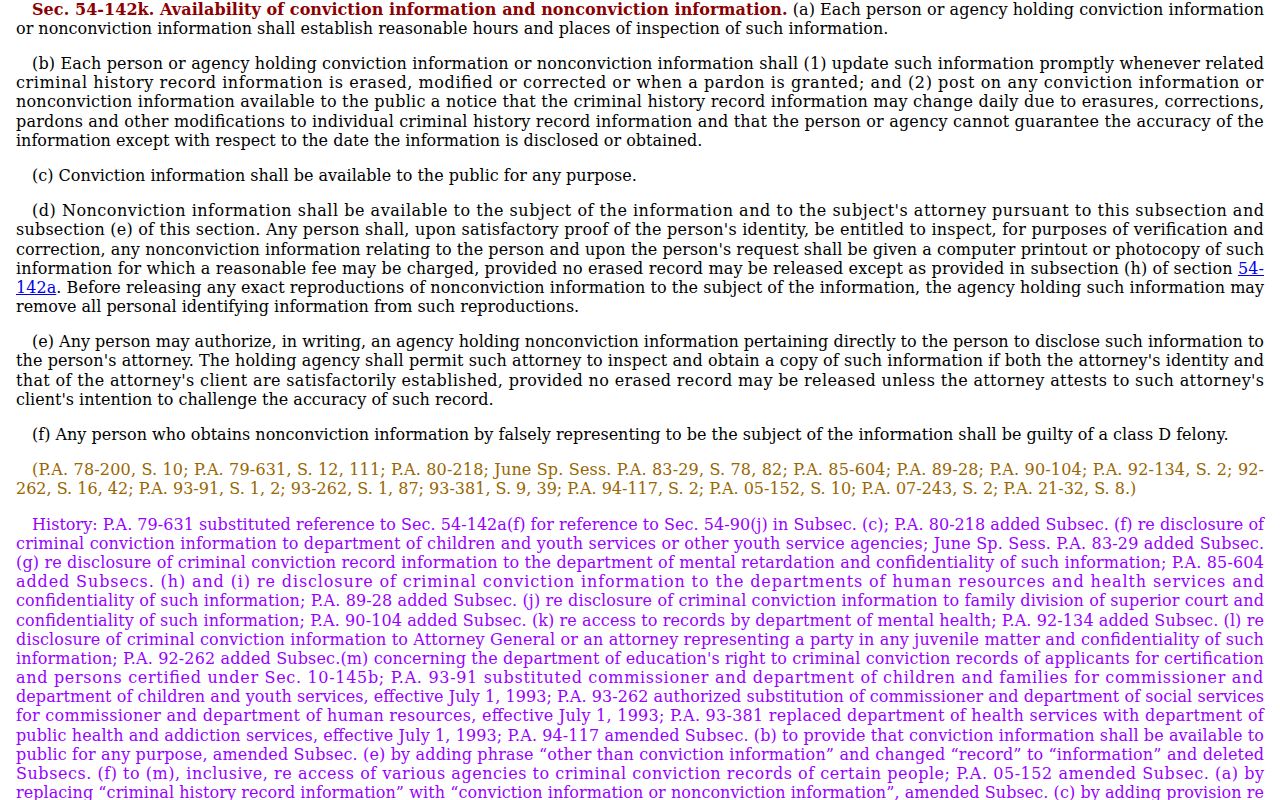
Use that distinction when reading any charge list. A pending or dismissed charge should not be treated as proof of conviction.
Sealed vs. Erased Charge Records
Connecticut's main concept is erasure. Not guilty findings, dismissals, nolles after at least 13 months, pardons, eligible misdemeanor and lower-felony convictions, and certain cannabis possession convictions may be erased under Connecticut statutes. Juvenile matter records are confidential, and juvenile police and court records have separate erasure rules. A sealed record is closed from public view, while an erased record is generally not disclosed except by statute.
| Sealed | Erased | |
|---|---|---|
| Visibility | Hidden from ordinary public search by order, rule, or statute. | Generally removed from public disclosure after statutory conditions are met. |
| Examples | Juvenile, youthful offender, protected victim, and sensitive sealed materials. | Dismissed, not guilty, nolled after waiting period, pardoned, and eligible conviction records. |
| Where to verify | Clerk or court order if the requester has standing. | Applicable erasure statute, clerk process, or DESPP review path when available. |
The Connecticut criminal-record erasure statute is a core source for reading old arrest and charge records.
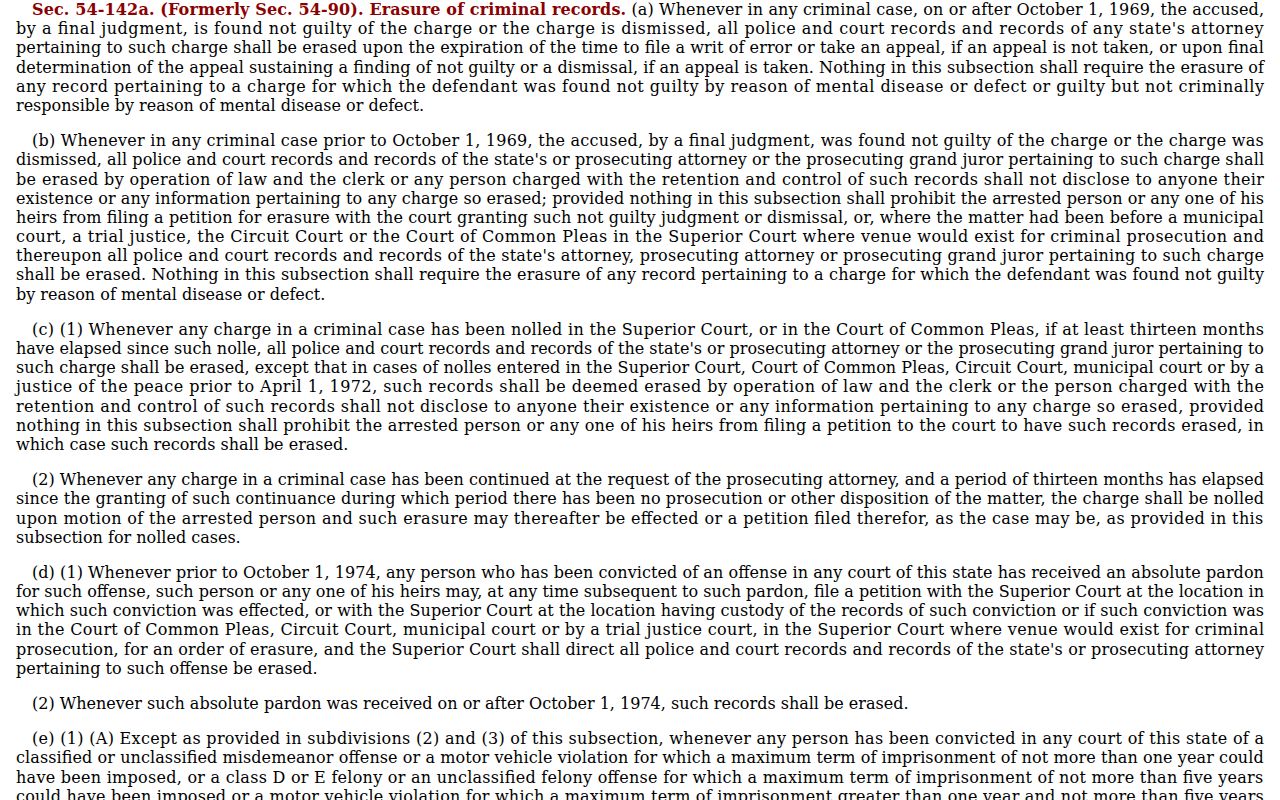
If a charge no longer appears in public lookup, erasure or confidentiality may be the reason rather than a search error.
New Haven Charge Codes and Levels
Charge codes tie a court accusation to a statute, offense class, or motor vehicle violation. New Haven geographical area offices prosecute many class C, D, and E felonies, misdemeanors, infractions, and motor vehicle offenses, while more serious Part A matters may be handled at the Judicial District courthouse. One arrest can lead to several charge lines, and each line may have a different statute, level, status, and disposition. Infractions and violation convictions are not shown on the public criminal conviction display described in the research.
Note: A charge code identifies an allegation; the disposition tells whether that allegation became a conviction.
Statewide Arrest and Charge Access
Connecticut's Judicial Branch lookup tools are statewide, so New Haven charge records are filtered inside statewide criminal/motor vehicle systems. Police arrest information may also be requested through the relevant law-enforcement agency under the arrest-record statute, subject to redactions and exemptions. Custody information is statewide through the Department of Correction, and New Haven Correctional Center is a state facility, not a county jail. DOC warns that current incarceration does not mean conviction because pretrial detainees may be held while cases are pending.
The Connecticut FOIA definitions statute helps explain public records in Connecticut, including why court case access and agency records do not always follow the same path.
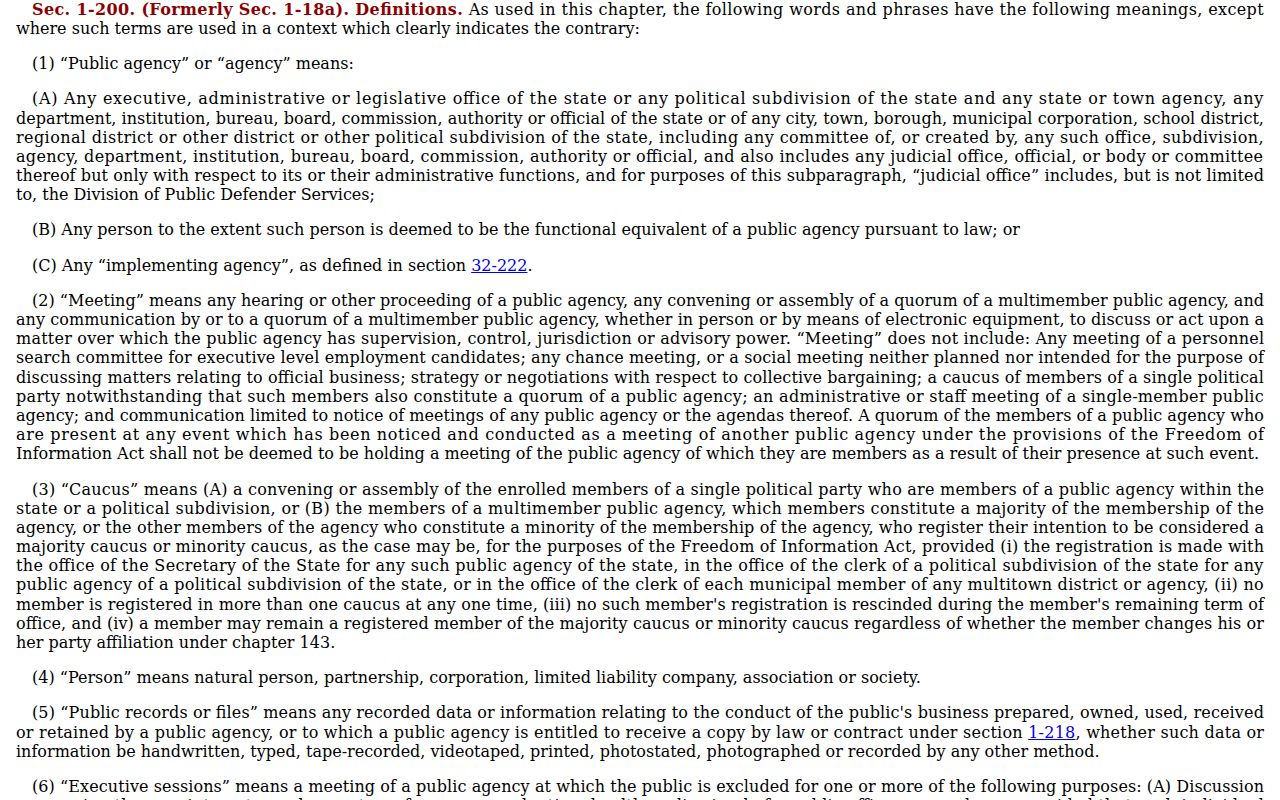
Use FOIA concepts for agency records, but use Judicial Branch lookup and clerk procedures for filed court charges.
Background Check Considerations
An arrest record or charge list is not a consumer background report. It may be incomplete, restricted, erased, or limited to public court display rules. It may also show an accusation that never became a conviction. Employers, landlords, insurers, lenders, and screening companies must use lawful FCRA-compliant processes when a report is used for regulated decisions. A casual lookup should be treated as a starting point that must be verified with the official court or agency record.
Important: Do not use arrest or charge lookup results as regulated employment, tenant, credit, or insurance screening reports.
Restricted New Haven Charge Records
Restricted charge records include juvenile matters under CGS 46b-124, youthful offender cases excluded from public criminal lookup, sealed charges, erased criminal records, protected victim details, and personal identifiers. Connecticut's automated erasure process can involve DESPP, the Judicial Branch, DOC, DCJ, and CJIS. Cannabis possession erasure rules also affect public display for certain convictions from January 1, 2000 to before October 1, 2015. If an expected New Haven charge record is missing, the record may be restricted, erased, filed under a different court code, or held by a different agency.